
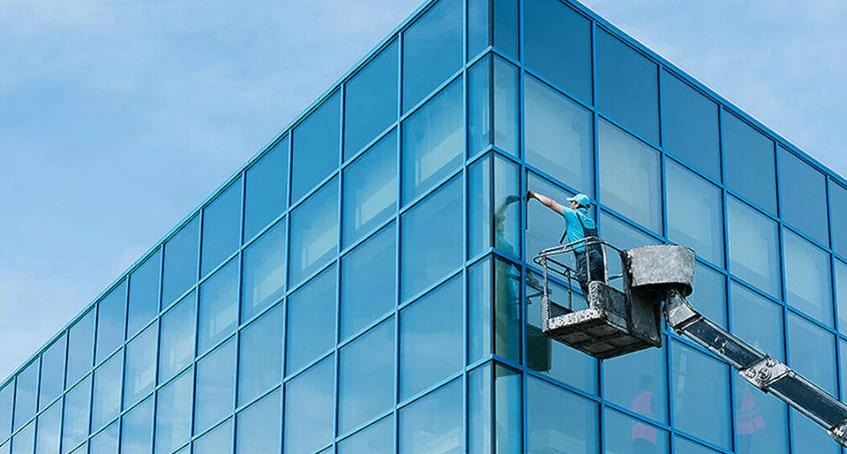
Retail glass is commercial glass under the hardest conditions. Storefronts face daily pedestrian traffic, shopping cart impacts, delivery vehicle proximity, and the weather exposure that comes from being on the ground floor of a building that’s open to the public. Entry doors cycle open and closed hundreds of times a day. Display windows are the first thing a customer sees before deciding whether to walk in.
When something fails in that environment — a storefront panel cracks, an entry door stops closing correctly, a door closer lets the door bang into a customer — the consequences are immediate and public. In retail, the maintenance problem is also a customer experience problem, a safety problem, and sometimes a liability problem, all at the same time.
Shopping center property managers face a version of this at scale. A center with twenty tenants has twenty storefronts, twenty entry systems, and twenty sets of tenant expectations for how quickly maintenance issues get addressed. One broken storefront on a Friday afternoon — and the tenant is calling before the glass has finished falling.
Speed of response is non-negotiable. A retail storefront with broken glass or a non-functional entry door is losing business while it waits for repair. The repair can’t be scheduled for next week. Emergency board-up needs to happen within hours; glass replacement needs to be on the fastest available timeline.
Customer-facing appearance matters through the repair process. A board-up on a retail storefront is visible to every customer who walks by. A professional, clean temporary closure maintains the property’s appearance while replacement glass is fabricated. A piece of plywood leaned against an aluminum frame does not.
Tenant lease requirements often specify response times. In managed shopping centers, tenant leases frequently include landlord maintenance obligations with response time requirements. A property manager who can’t document fast, professional response to a glass failure has a lease compliance issue on top of the maintenance issue.
High-traffic entry hardware wears faster in retail. An entry door that gets used two hundred times a day wears closers, hinges, and hardware at a rate that office buildings don’t approach. Retail entry hardware typically needs more frequent adjustment and replacement than comparable systems in lower-traffic commercial buildings.
✓ Storefront glass broken by shopping cart impact, vehicle proximity, or vandalism
✓ Entry doors that no longer close or latch correctly under heavy daily traffic
✓ Door closers that have lost calibration — closing too fast, too slow, or incompletely
✓ Display window glass cracked or damaged
✓ After-hours emergency board-up for broken storefronts
✓ Full storefront glass replacement with minimum disruption to retail operations
✓ Hardware replacement on high-traffic entry doors
✓ Multi-tenant shopping center glass service for property managers
Managing glass and door maintenance across a multi-tenant retail center is a coordination challenge as much as a maintenance challenge. Tenants operate on different hours, have different sensitivity to disruption, and have different expectations for how quickly maintenance gets addressed.
We work with shopping center property managers as the primary contact — scheduling around tenant hours, communicating directly with tenants on access when you authorize it, and providing documentation that supports your maintenance records and tenant communication.
For centers with recurring glass maintenance needs — high-traffic anchors, centers with frequent delivery vehicle proximity issues, centers with older storefront systems — we can provide scheduled service relationships rather than purely reactive response.
North Creek Commercial Glass serves businesses throughout King, Snohomish & Skagit Counties with commercial glass, commercial door, storefront, and emergency glass repair and replacement services.